What’s changing on Young Platform with MiCAR

Before we start: what is MiCAR and why does it matter to you?

MiCAR (which stands for Markets in Crypto-Assets Regulation) is the unified European regulation that, from 30 June 2026, governs the operation of crypto platforms across the European Union. To draw a comparison, it is very similar to the banking regulations introduced in the 2000s: a set of harmonised rules defining how crypto platforms must treat customers, custody their assets, disclose risks, and manage conflicts of interest and complaints.

Young Platform was authorised as a CASP (Crypto-Asset Service Provider) by Consob and Banca d’Italia on 30 June 2026. From that date, we have updated our entire platform to comply with these rules. This guide explains — in practical terms — what has changed from your perspective as a customer.

If you have already read our “Base vs Pro” guide, you will find the other updates here. If you haven’t read it yet, we highly recommend doing so first. You can find the link here: Guide to understanding Young Platform Base and Young Platform Pro post-MiCAR. Concepts such as Bilateral Trade, Execution Policy, Order Book, and Limit Orders apply here too.

1. The YNG Token will temporarily only be available on Base, not Pro

What has changed

Prior to 1 July 2026, you could buy and sell the YNG Token (Young Platform’s proprietary token) on both Young Platform Base and Young Platform Pro. Since 1 July 2026, it has been available only on Base. It is no longer possible to place buy or sell orders for YNG on the Pro platform. All pending YNG orders on Pro were automatically closed during the maintenance window on the night between 30 June and 1 July, and your Euro/crypto funds were returned to your available balance.

Please note: Any YNG holdings you had in your “vault” (custody) have not been affected. If you had 500 YNG in your wallet, they are still there. Only the way you buy and sell them has changed: from now on, you will do this on Base.

Why

On the Pro platform, Young Platform acts as an intermediary, sourcing the best counterparty across external markets (other exchanges). However, the YNG token is not yet admitted to trading on other qualified external exchanges connected to Young Platform. Consequently, there was effectively no external market for it on Pro.

What you need to do

If you previously used Pro to buy or sell YNG, you must now use Base (either via exchange.youngplatform.com or the updated mobile app). The process remains the same: you see the price, you have 5 seconds to accept it, and the transaction is settled directly with Young Platform.

This service may return to Pro in the future, if and when YNG is admitted to trading on external qualified exchanges. Young Platform will notify you well in advance if this happens.

2. Withdrawals and deposits: new transfer verification rules

This is likely the most noticeable update for anyone transferring crypto between Young Platform and external wallets. The rules vary depending on where the crypto is going (or coming from) and the amount involved.

The golden rule (always applicable): you can only transfer to your own wallets

First and foremost, this is the most critical rule to remember, and it applies to any transaction amount, without exception: you cannot send crypto from Young Platform to a non-custodial wallet (such as MetaMask, Ledger, Trezor, etc.) registered to someone else. This applies even if they are your parent, sibling, best friend, or a merchant. The same rule applies to incoming deposits: if crypto enters your Young Platform account from a non-custodial wallet, that wallet must belong to you, not a third party.

This restriction stems from the European Travel Rule Regulation (Regulation EU 2023/1113) and applies regardless of the monetary value: even a €5 transfer is prohibited if the destination non-custodial wallet cannot be proven to be yours. If you attempt this, the platform will block the transfer, and your crypto will remain held until the transaction is cleared.

For wallets held with other authorised exchanges (e.g., Coinbase, Kraken, etc.), specific checks are also carried out.

How Young Platform verifies that a non-custodial wallet is actually yours

A non-custodial wallet is one where only you hold the private keys. Examples include MetaMask, Ledger, Trezor, Trust Wallet, and Rabby. The way Young Platform verifies ownership depends on the transfer amount.

  • If the amount is under €1,000: A dedicated screen will appear where you must tick a box declaring, under your own responsibility, that you are the sole owner of the wallet and the private keys. This is a legally binding self-declaration: declaring false information carries personal liability. Without ticking this box, the transfer cannot proceed.
  • If the amount is €1,000 or more: Self-declaration is no longer sufficient. You will be asked to provide a formal cryptographic signature. This is required to objectively prove — rather than just declare — that you possess the private keys to that wallet.

What “cryptographic signature” means in simple terms

A cryptographic signature is a mathematical signature. It is not a written declaration, but a technical process: it involves using your wallet’s private keys to sign a unique message sent to you by Young Platform. If you are the genuine owner of the wallet, you will be able to generate this signature. If you are not, you won’t. It is the equivalent of proving you own a car by not just showing the logbook, but actually starting the engine with your key in front of a notary.

The practical steps on your screen are fully guided:

  1. Young Platform displays a message.
  2. You open your non-custodial wallet.
  3. Your wallet prompts you to confirm the signature (usually via Face ID, PIN, or by tapping your Ledger/Trezor hardware device).
  4. Your wallet generates the signature and transmits it to Young Platform.
  5. If the signature is valid, Young Platform releases the transfer. If it is invalid (or if you do not complete it), the transfer will be rejected and your crypto will remain in your Young Platform account.

The technical service provider Young Platform uses to manage this signature verification is Notabene, a platform specialising in Travel Rule compliance.

If the wallet is on another exchange

In this case, the logic is different. A wallet on another authorised exchange does not have “private keys” that the customer can sign — the hosting exchange holds them. Therefore, cryptographic signing does not apply.

Instead, the Travel Rule requires an automatic exchange of data between Young Platform and the destination exchange. Specifically:

  • When you set up the transfer, Young Platform will ask you for the recipient’s personal details (first name, surname, and whether they are you or someone else).
  • Young Platform and the receiving exchange will automatically and securely exchange this data in an encrypted format using an international technical standard called IVMS101 (essentially a “common language” for crypto platforms).
  • If the other exchange confirms the details, the transfer goes through.
  • If the other exchange does not respond or provides incomplete data, the transfer will be temporarily held, and Young Platform will ask you to manually provide the missing details before releasing it.

Once again, Notabene is the technical tool orchestrating this secure data exchange between platforms.

What is the Travel Rule (and why does it exist)?

The Travel Rule is a regulatory standard introduced by the European Union under Regulation EU 2023/1113. Essentially, it dictates that specific identifying data must “travel” with the transaction, just as it does with international bank transfers. If a bank processes a €10,000 transfer to another bank, it must specify the sender and the recipient — name, address, and IBAN. The crypto Travel Rule operates in the same way, with minor technical adjustments (using blockchain addresses instead of IBANs).

The objective is to prevent money laundering and terrorist financing: by ensuring every crypto movement is traceable, it becomes significantly harder to move illicit funds through regulated platforms.

What happens if a transfer gets blocked?

This can happen for several technical reasons:

  • The receiving exchange fails to respond to the data exchange promptly.
  • The sent data is incomplete.
  • Your non-custodial wallet fails to sign due to a technical error.
  • The destination address is flagged on a suspicious list (such as sanctioned addresses, known scams, etc.).

In all these scenarios, the transfer goes into a temporary block. Your crypto will not leave your account and will not reach the recipient until the issue is resolved. You will receive an in-app notification explaining what is missing and what you need to do (for example, providing the signature again, updating the recipient’s details, or contacting Customer Support).

Please do not worry if this happens: it is a protective security mechanism, not a penalty. If you have any doubts, get in touch with Customer Support straight away.

What is the Transfer Policy (in a broader sense)?

It is worth distinguishing between two documents that sound similar but cover different areas:

  • The Crypto-Asset Transfer Policy (Article 80 MiCAR) is the document where Young Platform outlines how it delivers its transfer services as a regulated activity: who is permitted to make transfers, how transfers are processed, what technical security measures are in place, and so on.
  • The Travel Rule Procedure (Regulation EU 2023/1113) is a more specific document detailing how Young Platform collects and exchanges the data that must accompany every crypto transfer, and how it implements cryptographic signatures for non-custodial wallets.

These two documents are designed to be read alongside each other.

What you need to do in practice

  • If you are transferring less than €1,000 to or from your own non-custodial wallet: Simply tick the self-declaration box when prompted. That is all.
  • If you are transferring €1,000 or more to or from your own non-custodial wallet: Be ready to perform the cryptographic signature (make sure your wallet is open on your phone or your hardware device is connected beforehand).
  • If the wallet is on another exchange: Provide the requested personal details; the rest is handled automatically in the background.
  • Never attempt to send crypto to another person’s non-custodial wallet (not even a family member): this is strictly prohibited at any transaction value. If you need to send crypto to someone, ask them to set up their own account on Young Platform or another authorised exchange.

3. Delisting: some cryptocurrencies are no longer available

What happened

With the introduction of MiCAR, Young Platform had to review the list of available cryptocurrencies on our platform. Some have been removed. The technical term for this is “delisting”, which simply means removing them from our available selection — much like a supermarket taking certain products off the shelves if they no longer meet new regulatory standards.

Why

The reasons vary depending on the specific crypto-asset:

  • Some stablecoins do not hold EMT (E-Money Token) status under MiCAR and therefore cannot be offered within Europe. USDT (Tether) is the most prominent example: as it is not yet compliant with MiCAR, it cannot be marketed as an EMT within the EU.
  • Some crypto-assets are deemed high-risk due to low liquidity, technical vulnerabilities, or concerns over project governance.
  • Some crypto-assets lack a MiCAR-compliant White Paper notified to the relevant competent authority, which is now a mandatory requirement for offering assets to the European public.

The fully updated list of supported cryptocurrencies is always available to view at youngplatform.com/en/exchange/listed/ and in our Terms and Conditions.

What you need to do

If you were affected, you will have received a dedicated notice from Young Platform outlining your options (such as converting the assets, withdrawing them to an external wallet, etc.) along with a deadline. If you don’t remember receiving this email, please check the email address associated with your account. If you have any questions, contact Customer Support.

4. Some trading pairs are changing: from USDC to EUR

What is a trading pair?

A trading pair (or “pair”) is the combination of two assets you are exchanging. If you buy Bitcoin using Euros, the pair is BTC/EUR. If you buy Bitcoin using USDC (a dollar-pegged stablecoin), the pair is BTC/USDC.

What has changed

Following 1 July 2026, Young Platform converted several trading pairs from USDC to EUR.

Why

There are two main reasons for this:

  • It is simpler for you: When you buy using EUR, you know exactly how much you are spending in your local currency. Buying in USDC requires extra mental steps (converting Euros to USDC, then USDC to BTC), and each step carries a small transaction cost. For European retail users, EUR pairs are far more intuitive.
  • Regulatory requirements: Under MiCAR, offering pairs against stablecoins that must meet specific criteria (authorised EMTs) involves stricter checks and disclosure requirements. In some cases, for operational efficiency, it is preferable for Young Platform to support the trading pair directly in Euros.

What you need to do

If you used to trade regularly against USDC on certain cryptocurrencies, check if the pair has switched to EUR. If it has, there is no cause for concern: you can continue making the same trade; you will simply pay and receive Euros instead of USDC. If you still require USDC, you can buy it separately just like any other cryptocurrency.

5. Moneybox (recurring purchases) and Recurring Staking

What is the Moneybox?

The Moneybox feature allows you to set up automatic, recurring purchases (weekly, bi-weekly, or monthly) for one or more supported cryptocurrencies.

These recurring Moneybox purchases are built on the same Bilateral Trade model described in our “Base vs Pro” guide. We have included a brief summary below, though we highly recommend reading the full guide.

What has changed

Quite simply, when you tap “Buy”, you are purchasing crypto directly from Young Platform. The platform acts as the sole dealer: Young Platform sells to you (or buys back from you) the cryptocurrency at the price displayed on your screen.

When setting up a recurring purchase plan via Moneybox, you will be asked for prior authorisation to execute these orders. This is designed to automate and simplify the recurring purchase process.

When a recurring purchase is executed through Moneybox, Young Platform applies a 1.89% fee on the transaction value for orders exceeding €100. For a complete overview of our fees, please visit this page.

Naturally, you can edit, pause, or cancel your Moneybox plan at any time, which will apply to all future scheduled orders.

What is Recurring Staking?

Recurring Staking allows you to schedule automatic purchases of crypto (on a weekly, bi-weekly, or monthly basis). Once purchased, the crypto goes straight into your Staking Wallet — which we will cover below — to start generating rewards automatically, with no further action required from you.

As with the Moneybox, purchases made through Recurring Staking follow the Bilateral Trade model.

What has changed

Each scheduled purchase via Recurring Staking works exactly like those authorised under the Moneybox feature: you buy the crypto directly from Young Platform at the real-time calculated market price, with fees following the same structure linked above.

As soon as the purchase is complete, the crypto is instantly moved into your Staking Wallet. We discuss this in more detail in the next section, but please keep in mind that, from a legal perspective, the Staking service is governed by its own contract and is not regulated under MiCAR.

By activating the plan, you authorise both the purchase and the transfer to your Staking Wallet in advance, with all costs clearly outlined from the start. Just like the Moneybox, you can modify, pause, or cancel your plan at any time. Any changes will apply starting from the next scheduled purchase.

If you cancel one or more stakes, any funds you have already accumulated will be automatically moved back to your Main Wallet.

The Staking Wallet is not a MiCAR-regulated service

What is the Staking Wallet?

The Staking Wallet is a service on Young Platform that allows you to “stake” certain cryptocurrencies (such as Ethereum) to receive periodic rewards. Technically, when you stake, your crypto is “locked” to help support the operations of the blockchain, and in return, you earn rewards over time.

Why we want to clarify that “it is not a MiCAR service”

Simply because MiCAR does not directly regulate staking. The European regulation covers activities such as exchanging crypto-assets (Article 77), executing orders on behalf of clients (Article 78), custody (Article 75), transfers (Article 82), advice, discretionary portfolio management, and placement. Staking as a standalone service is not covered.

This leads to two key practical implications:

  • MiCAR protections (such as custody asset segregation, risk disclosures, and provider requirements) apply to the underlying custody service, not to the staking service itself.
  • Staking carries specific risks that are not covered by the MiCAR framework, which you should be fully aware of before activating it. These include slashing risk (where a portion of your staked crypto can be confiscated if the validator makes an error), protocol risks (for example, Lido for Ethereum), potential lock-up periods during which you cannot withdraw, and de-pegging risks for derivative tokens like wstETH (Wrapped Staked Ether).

What you need to do

If you use the Staking Wallet, please carefully read the specific Terms and Conditions of the Staking Wallet and the dedicated risk disclosures published at youngplatform.com/staking-wallet/. These are separate from Young Platform’s General MiCAR Terms and cover specific details such as:

  • How rewards are calculated.
  • When you will receive them.
  • Which cryptocurrencies are staked and with which protocols/validators.
  • How the “unstaking” (withdrawal) process works.
  • What happens in the event of protocol slashing or technical issues.

In summary: The Staking Wallet is just as secure as before, but it is a distinct service from MiCAR-regulated services, governed by its own rules and risks. Please treat it as such.

Key takeaways in a nutshell

If you only remember the most practical points from this guide, make sure they are these:

  1. YNG can only be bought and sold on Base, no longer on Pro.
  2. Transfers to non-custodial wallets: Only to your own wallet (never to third parties, regardless of the amount). For amounts under €1,000, a self-declaration checkbox is enough; for €1,000 and above, a cryptographic signature is required. If the wallet is on another exchange, personal data is exchanged automatically via Notabene (Travel Rule).
  3. Certain cryptocurrencies have been removed from the platform. If you held any of these, you have already been notified of your options.
  4. Some trading pairs have changed from USDC to EUR, improving price transparency.
  5. The Staking Wallet and the DeFi Wallet are not MiCAR services. They have their own rules and risks: make sure to read their dedicated disclosures.

Questions & Answers

1. Do I need to download a new app for the cryptographic signature?

No. If you already have a non-custodial wallet (such as MetaMask, Ledger, Trust Wallet, etc.), you will perform the signature directly within that wallet. If you do not have a non-custodial wallet and only want to transfer crypto to accounts on other exchanges (like Coinbase or Kraken), you do not need one: you will simply follow the “proof of account ownership” procedure.

2. Does the €1,000 limit apply to a single transfer or the total amount over a certain period?

It applies to individual transfers, in line with Young Platform’s Travel Rule Procedure. A withdrawal of €990 to your own non-custodial wallet only requires you to tick the self-declaration box; a withdrawal of €1,000 (or more) requires a cryptographic signature. Please note: systematically splitting transactions to bypass this limit may trigger additional anti-money laundering checks on your account.

3. If I place a large amount of funds into staking, am I violating any MiCAR rules?

No, staking is not prohibited. It is simply not regulated under MiCAR as a standalone service. You can continue to use it, but please ensure you understand the specific risks involved (such as slashing, lock-up periods, and protocol-specific risks).

4. Is the value of my crypto guaranteed by anyone now that MiCAR is in force?

No. MiCAR ensures transparency, fair conduct by the platform, asset custody segregation, and your right to file complaints. It does not guarantee the value of your cryptocurrencies, which remain subject to market volatility. Cryptocurrencies do not benefit from protection schemes equivalent to the Interbank Deposit Protection Fund.

5. What should I do if I have an issue with a blocked withdrawal or a signature that won’t process?

Please reach out to Customer Support at support.youngplatform.com. If you are not satisfied with the response, you can submit a formal complaint via youngplatform.com/legal/complaints/. As a last resort, you can contact Consob, Banca d’Italia, or initiate an Alternative Dispute Resolution (ADR) procedure.

6. Why are there so many checks now? It feels more complicated than before.

This is a very fair question. MiCAR was created for a simple reason: to bring crypto into a regulatory framework similar to other financial services, ensuring that anyone using a European crypto platform enjoys protections comparable to banking customers. Some checks (like the cryptographic signature for larger transfers) are the crypto equivalents of verifying an IBAN during a bank transfer. While they might feel like an extra step at first, they will soon become second nature — and they protect you just as much as they protect the platform.

This guide is for informational purposes only. It does not constitute investment advice or a personalised recommendation. For binding contractual terms, please refer to Young Platform’s General Terms and Conditions, the Crypto-Asset Transfer Policy, the Custody Policy, the Best Execution Policy, and other official disclosures published at youngplatform.com/legal.

A Guide to Understanding Young Platform Base and Young Platform Pro Post-MiCAR

When you open the Young Platform app or website, even though you use the same credentials (email and password) to log in to your account, you are actually faced with two different ways of buying and selling crypto. They are called Young Platform Base and Young Platform Pro. They seem like two similar products, but beneath the surface, they operate very differently — and understanding this difference helps you choose the right one for you.

The difference can be summarised as follows:

  • On Base, you buy or sell directly from Young Platform, just like you would in a high street shop.
  • On Pro, you ask Young Platform to look for the best offer on other markets for you, acting as your “personal shopper”.

In the rest of this guide, we explain what actually changes, what happens when you press “Buy”, what “bilateral execution” means, what the famous “Execution Policy” is, and — most importantly — which of the two modes to choose based on your needs.

The Two Modes, Explained with an Analogy

Young Platform Base = Your Trusted Local Shop

Imagine you want to buy a kilo of apples. You go to your local corner shop. The shopkeeper takes the fruit from his shelf and tells you: “A kilo of apples is €3.” You agree, pay, and walk out with your bag. The transaction is directly between you and him. There is no one else in between. If wholesale apple prices go up tomorrow, that’s the shopkeeper’s business — the price he gave you is already locked in.

How it works on Young Platform Base: when you tap “Buy Bitcoin”, Young Platform shows you a price. If you accept, you are buying Bitcoin from Young Platform. Young Platform is your counterparty: they are the ones selling to you (or buying from you) the crypto. It is the simplest, most immediate option, perfect for those who want to make quick transactions without having to think about anything else.

Technical jargon refers to this mode as “bilateral exchange” because only two parties are involved: you and Young Platform. In legal terms, it is the “service under Article 77 of MiCAR” (MiCAR being the European Markets in Crypto-Assets regulation).

Young Platform Pro = Your Personal Shopper

Now, imagine instead that you want to buy a kilo of apples at the absolute best price in town. You don’t want to trust just one shopkeeper; you want someone to go around all the markets, compare prices, and buy where it is cheapest for you. You delegate this task to an assistant. You give them instructions (“buy 1 kg of Golden Delicious apples, do not spend more than €3”). They go out, search, buy on your behalf, and bring you your shopping. If they cannot find anyone selling at that price, they return empty-handed.

How it works on Young Platform Pro: when you place an order, Young Platform does not sell you the crypto directly. Instead, it goes out to find the best available counterparty on other markets (other crypto platforms) and buys on your behalf. In this mode, Young Platform acts as an intermediary, not a seller.

In technical terms, this mode is called “execution of orders on behalf of clients” or the “service under Article 78 of MiCAR”.

What Actually Happens When You Press “Buy” or “Sell”

On Young Platform Base

  1. Open the trading screen, choose the crypto and the amount (either in crypto or fiat/euros).
  2. Young Platform shows you a guaranteed price for 5 seconds (30 seconds if you are buying with a card, Apple Pay/Google Pay, or using the assisted OTC channel, i.e., via phone/chat with an operator). In the industry, this is called a “firm quote”: it means a “locked-in price”, meaning that if you accept it within those 5 seconds, Young Platform is obliged to honour it.
  3. Before confirming, you will see the final total price (referred to as “Total Consideration”) — which is exactly how much the transaction will cost you, including fees.
  4. If you accept within 5 seconds, the transaction is complete. Your euros (or crypto) leave your account, and the crypto (or euros) enter immediately.
  5. If you do not accept in time, the price expires, and a new quote (updated to reflect the current market) is generated.

The “price” you see does not appear out of thin air: Young Platform has an internal system called the Pricing Engine. It is an automated engine that monitors crypto prices across major global markets (large international crypto platforms) and adds a margin (the spread) to lock in and guarantee the price for you. The Pricing Engine always operates the same way, using predefined, clearly written rules; no human decides whether to charge you more or less. The calculation rules are detailed in a public document called the “Cryptocurrency Exchange Procedure”, which is described in the Terms and Conditions.

On Young Platform Pro

  1. Open the Pro screen, choose the crypto, the quantity and — starting from 1 July 2026 — the maximum price (for buying) or minimum price (for selling) at which you want your order to be executed.
  2. Your order is a Limit Order Fill-or-Kill (FOK). Let’s break down what this means in simple terms:
    • Limit Order = an order with a price limit, meaning “only execute if the price is equal to or better than the one I am specifying”.
    • Fill or Kill (FOK) = “all or nothing”. If there is sufficient supply at my price to fill the entire order, execute it immediately. If not, cancel the whole thing; I don’t want partial executions.
  3. Your order goes into a Young Platform module called the Smart Order Router (“SOR”).
  4. The Smart Order Router looks at all the external markets (liquidity providers) connected to Young Platform and decides where to route the order to get the best result for you. The rules it follows to make this decision are laid out in a public document called the Execution Policy (see below).
  5. If the Smart Order Router immediately finds a counterparty at your price, the order is executed. If not, the order is cancelled, and your money remains exactly where it is. In trading terms, this is called a “kill” (cancellation).
  6. On Pro, the price you pay is not decided by Young Platform: it is decided by the external market where the order is executed. Young Platform simply routes your order there and delivers the outcome back to you. Young Platform adds an intermediary commission (which is transparently shown in the fee schedule) to the amount paid to the external market.

In short, keep these operational rules in mind:

  • Purchase: you must set a price that is equal to or higher than the current market price; otherwise, the order will be cancelled (KIL).
  • Sale: you must specify a price equal to or lower than the market price to prevent the order from being cancelled (KIL).

Detailed Fee Calculation

On Young Platform Base

The amount you enter always represents the gross value you wish to spend or the net value you wish to receive.

Specifically:

  • In the case of a purchase in EUR, the fee is deducted from the amount entered.
  • For a purchase with a crypto amount (e.g. BTC), the fee in EUR is added to the required total.
  • If a sale is set for an amount in EUR, the fee is applied to ensure you receive exactly the desired amount.
  • In a sale with a crypto amount (e.g. BTC), the fee is deducted from the proceeds of the sale.

On Young Platform Pro

For Pro, the system operates based on the so-called “left-hand currency” (the cryptocurrency of the trading pair):

  • Buy Transaction: the intermediary commission is added to the transaction value. The total cost charged will therefore be calculated as (quantity * execution price) + commission. This ensures that the requested quantity of crypto is purchased in full, with the service cost added to the total in EUR.
  • Sell Transaction: The commission is deducted from the gross proceeds obtained from the trade. The net amount you receive in your wallet will be calculated as: (quantity * execution price) – commission.

Meaning of “Execution Policy”

Although it may seem complex, the Execution Policy is simply the internal set of regulations that guides Young Platform in choosing the most suitable market to execute orders on the Pro platform. Using the personal shopper analogy: it is the set of instructions you give to the person buying on your behalf.

Therefore, the Execution Policy is the regulatory framework Young Platform sets for itself to decide where to execute your order on Pro. Going back to our shopping assistant analogy: when you commission someone to buy for you, you want them to follow specific rules so you don’t get any surprises. For example:

  • “Go where it’s cheapest first.”
  • “But if the cheapest shop is closed for half an hour a day, it’s better to go to a reliable one that is always open.”
  • “If you need to buy 10 kg, go to a supermarket that definitely has it in stock, not a small shop that might only have 2 kg.”

Young Platform’s Execution Policy is the formal, written version of these rules. The European MiCAR regulation requires anyone performing execution on behalf of clients to have a written Execution Policy and specifies which factors must be considered when deciding where to send the order. These are called “Best Execution factors” and are:

  • Price: where it costs less (or yields more, if you are selling).
  • Total costs: not just the price, but also commissions and ancillary costs.
  • Speed of execution: how quickly the order is completed.
  • Likelihood of execution and settlement: how likely it is that the order will actually be completed and the crypto will reach its destination.
  • Size of the order: buying a fraction versus a massive amount is not the same; the best market can change.
  • Nature of the order: certain unique orders require specific markets.

Young Platform weighs these factors based on a public hierarchy of importance it has established. You can view it here: youngplatform.com/en/legal/best-execution-policy/.

Note: The Execution Policy only applies to Pro (because on Pro, Young Platform acts as an intermediary). There is no Execution Policy on Base, because Young Platform is your direct counterparty and the price is set by the Pricing Engine — which follows a different methodology.

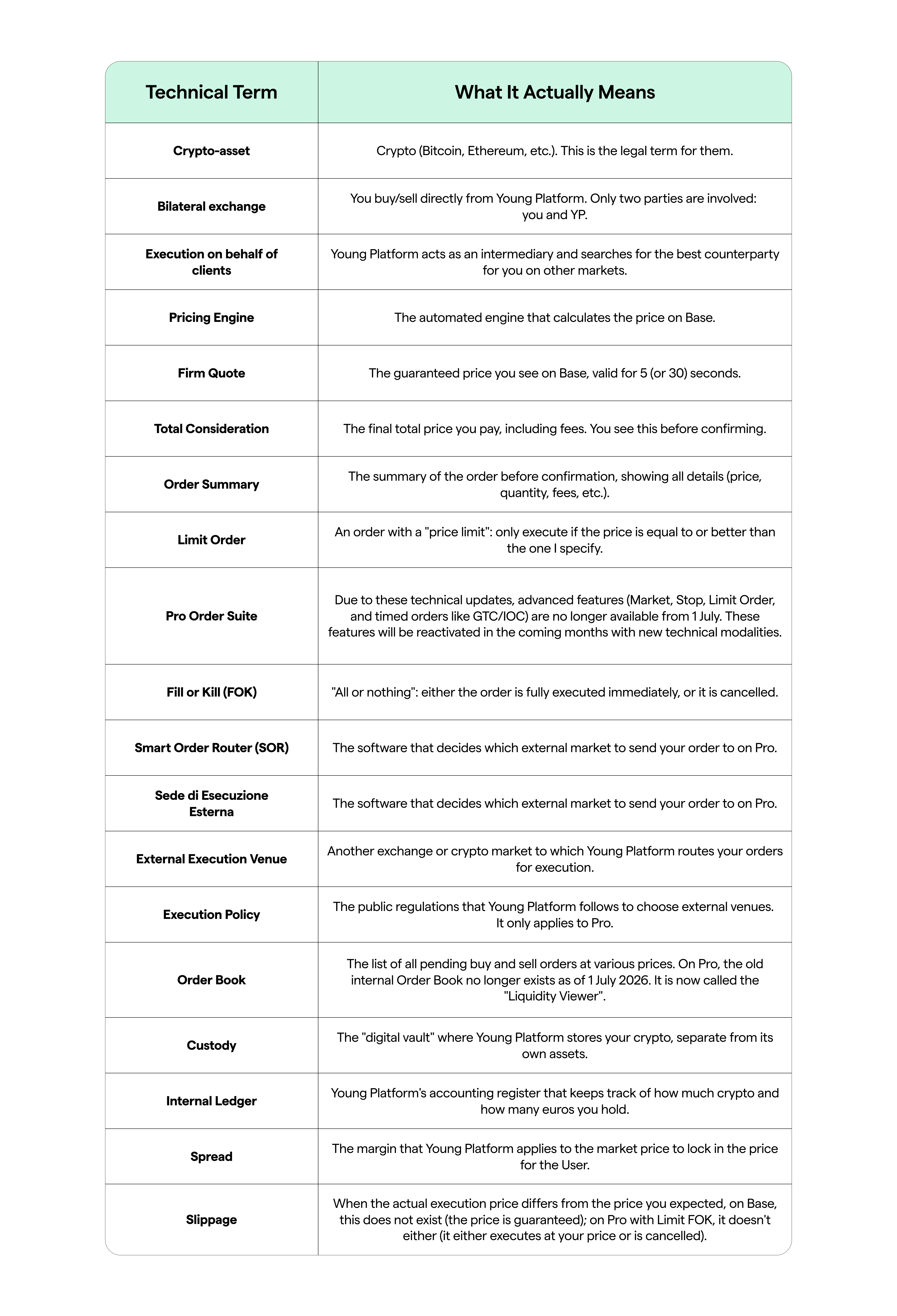
Common Technical Terms, Translated into Plain English

Base or Pro: Which to Choose?

Choose Young Platform Base if…

  • You are new to crypto and want something straightforward.
  • You care more about price certainty than finding the absolute best price.
  • You make small to medium-sized transactions (from a few euros to a few thousand) without recurring thresholds.
  • You don’t want to worry about “where” your order is being executed: you just want to know how much you are paying and how much you are receiving.
  • You prefer to know the exact cost of the transaction upfront, before pressing “Confirm”.

Choose Young Platform Pro if…

  • You have some experience and want to see what price the market can offer you in real-time.
  • You want to set a maximum (or minimum) price and avoid having your order executed if it is not reached.
  • You make larger transactions and want Young Platform to seek out the best external counterparty for you.
  • You are willing to accept that your order might be completely cancelled if it does not find an immediate counterparty at your price (the risk of the Fill or Kill mode).

A Special Case: OTC Desk

If you need to make a large transaction (typically over €20,000) and want a pre-determined price agreed upon with a human operator, there is the OTC Desk channel. It works like this: you call (or write in an authenticated chat) a Young Platform operator, explain what you want to do, the operator sends you a firm quote valid for 30 seconds, you accept (or reject) it, and the transaction is complete. Technically, this remains a bilateral exchange just like Base, but with dedicated assistance.

What Happens to Your Crypto: Custody

Whether you operate on Base or Pro, the crypto in your account always remains in the same digital vaults at Young Platform. This service is called custody and is governed by Article 75 of the MiCAR regulation.

The main rules are:

  • Segregation: your crypto is kept separate from Young Platform’s own assets. If Young Platform were to face financial difficulties tomorrow, your crypto would not end up in the creditors’ pool: it is yours, plain and simple.
  • Internal Ledger: there is an accounting register that tracks exactly what belongs to each client. Every time you buy or sell, the register updates.
  • Secure Tech Wallets: crypto is stored using specific technologies (fractional keys, specialised tech custodians) to protect it from cyber theft.

Please note — highly important: custody does not eliminate market risks. Crypto values can rise or fall by 50% or more in a single day. Custody means your crypto is physically/digitally secure, not that its value is guaranteed.

Frequently Asked Questions

1. If I buy Bitcoin on Base, who sells me the Bitcoin? Young Platform sells them to you. They are your contractual counterparty. The BTC you receive are taken from Young Platform’s “warehouse” (inventory).

2. If I buy Bitcoin on Pro, who sells me the Bitcoin? An external market (another platform) sells them to you. Young Platform acts solely as an intermediary: it takes your order, routes it to the market chosen according to its Execution Policy, and delivers the BTC back to you.

3. What happens if I place an order on Pro and nobody wants to sell at my price? The order is cancelled in its entirety (the “Kill” in Fill or Kill). Your funds remain untouched in your account, and you can try again with a different price.

4. What is the “chart” I see on Pro if the internal Order Book no longer exists? The chart shows historical crypto prices across the main external markets (liquidity providers) to which Young Platform connects. It is for informational purposes only: it helps you decide at what price to place your Limit Order.

5. If I have a problem, who do I talk to? Young Platform’s Customer Service, which you can reach at support.youngplatform.com/hc/en-us. If you are not satisfied with their response, you can submit a formal complaint via the process outlined at youngplatform.com/en/legal/complaints/. As a last resort, you can contact the Italian supervisory authorities (Consob and the Bank of Italy).

6. Are my crypto-assets guaranteed like bank deposits? No. Crypto-assets are not covered by the Interbank Deposit Protection Fund (which protects bank accounts up to €100,000) or the National Guarantee Fund (which protects financial security, investors). The European MiCAR regulation requires all authorised platforms to state this clearly. This does not mean your crypto is less protected from theft or Young Platform’s insolvency — custody with segregation protects you from that. It means no one guarantees the value of the crypto: if it drops, it drops. It is important to highlight, however, that Young Platform has taken out targeted insurance policies designed both to protect against cybersecurity risks and to safeguard the assets held in custody.

Key Takeaways Before You Begin

  • On Base, your counterparty is Young Platform. You get a guaranteed price before confirming.
  • On Pro, Young Platform acts as an intermediary to external markets (liquidity providers). You specify the price (Limit), and if no counterparty is found at your price, the order is cancelled.
  • The Execution Policy is the set of regulations Young Platform follows on Pro to choose where to route your orders. It is public.
  • Your crypto is held separately from Young Platform’s funds (accounting segregation). It is safe from YP’s corporate issues, but not from market risk (crashes, volatility).
  • Crypto is not guaranteed like bank deposits or traditional financial investments.
  • If you don’t understand something, stop: read the official documentation, contact Customer Support, and do not press “Confirm” without understanding what you are signing.

This guide is for informational purposes only. It does not constitute investment advice or a personalised recommendation. For the complete and legally binding contractual conditions, please refer to the General Terms and Conditions of Young Platform published at youngplatform.com/legal.

How the Stock Exchange works, explained simply

How does the stock market work?

NYSE, Nasdaq, LSE – what do these names mean? They refer to some of the world’s leading stock exchanges. But what exactly is a stock exchange, and how does it work?

The stock exchange, more commonly known as the stock market, is a financial marketplace where shares, bonds, and other securities are bought and sold. Once considered the domain of financial insiders, the stock market has now entered popular culture, thanks in part to numerous cult films that have graced cinema screens since the 1970s.

But what is the history of the stock exchange? What are its key components? And who are the leading players involved? Let’s take a closer look.

How and when was the stock exchange created?

The earliest recorded evidence of trading, lending, and deposit activities dates back to the second millennium BC, inscribed in the Babylonian Code of Hammurabi. Similar financial practices were also found among the ancient Greeks, Etruscans, and Romans.

However, these early forms of financial exchange cannot truly be considered a ‘stock market’ as we understand it today. The first genuine stock exchange was established in Amsterdam, in the Netherlands, around the 17th century.

The Middle Ages

In the late Middle Ages, the world of finance began to take on a more structured form with the emergence of the first banking institutions. Italy – particularly the cities of Genoa, Venice, and Siena – was, for many years, the central financial hub of Europe.

Around the 14th century, a new trading centre emerged that attracted merchants from across the continent, helping to shape a financial system that was still quite rudimentary. This was in Bruges, Belgium, specifically in the Ter Buerse Palace, built by the aristocratic Van der Bourse family. It was here, where merchants gathered to exchange goods and currencies, that the name ‘Borsa’ (stock exchange) originated.

Later, essential exchanges were established in Antwerp, Lyon, and Frankfurt, marking a shift from private to public management, with increasingly clear and stricter regulations.

The Modern Age

In the 17th century, the Amsterdam Stock Exchange became the most important in Europe – and likely in the world. This period also saw the creation of the first joint-stock companies, which significantly boosted the trading of securities, including government bonds and commodities.

The 18th century witnessed the rise of international trade, as well as the emergence of speculative bubbles. The most famous was the South Sea Bubble in England (1710–1720), when share prices soared before collapsing, causing heavy losses. It led to the Bubble Act, a law aimed at curbing speculation by limiting the formation of new companies.

Meanwhile, in New York, a group of merchants began meeting under a plane tree on Wall Street to trade securities – a humble beginning for what would become a future global financial centre.

The Industrial Revolution and the modern stock market

During this period, the stock market became crucial not only for company growth but also for the economic development of entire nations. London and Paris became key financial markets, funding industrial projects, infrastructure, and even colonial and military ventures.

In 1817, the New York Stock Exchange (NYSE) was officially established. Over time, it would grow to become the world’s largest stock exchange by market capitalisation.

The 20th century: successes and severe financial crises 

By 1900, the stock market had become the beating heart of the capitalist system. Economics and finance were now deeply interconnected. It was a century marked by sharp contrasts, alternating between periods of remarkable economic growth – such as the Roaring Twenties and the post-World War II boom – and severe financial crises, including the Great Depression of 1929 and Black Monday in 1987.

This volatility highlighted the need for regulation. Supervisory authorities such as the SEC (Securities and Exchange Commission) in the United States and Consob (National Commission for Companies and the Stock Exchange) in Italy were established to oversee financial markets, which were now dealing with enormous capital flows.

In 1971, the Nasdaq was founded, marking the beginning of the stock market’s transition from a physical trading floor, filled with shouting and hand signals, to an electronic system driven by computers and algorithms.

The digital age

Fast forward to today: the rise of the Internet has transformed how the stock market functions. It has brought greater accessibility, instantaneous transactions, unprecedented capital mobility, and the emergence of entirely new markets.

Now that we’ve explored its history, let’s take a closer look at how the stock market works today.

How does the stock market work?

To understand how the stock market works, it’s first essential to understand what it is. The stock market can be described as the financial engine that links the world of businesses with that of savers and investors. On one side, companies seek capital to fund their growth – whether by opening new branches, developing new products, or hiring staff. On the other hand, individuals look for opportunities to grow their savings. This is where the concepts of primary and secondary markets come into play.

The primary market is where shares are created. When a company lists on the stock exchange for the first time, it sells its shares directly to investors – a process known as an IPO (Initial Public Offering). Investors, by purchasing these shares, provide the company with the necessary funds to grow.

The secondary market, on the other hand, is the market in which existing shares are bought and sold between investors on a daily basis. Companies do not earn money from these transactions, but the market allows investors to profit from rising prices.

But shares are not the only financial instruments traded on the market. A large portion of investments also involves bonds. Understanding the difference between the two is fundamental.

What are shares?

As mentioned earlier, shares represent small units of ownership in a company. Investors buy them with the hope of selling them later at a higher price. Even by purchasing a single share, an investor becomes a partial owner of the company.

This ownership grants specific rights, such as receiving dividends (a portion of the company’s profits, although not always guaranteed) and participating in shareholder meetings.

However, buying shares comes with risks. Share prices are closely tied to the company’s performance. If the business thrives, the price typically increases. If it struggles, the cost can fall – sometimes dramatically. In extreme cases, shares can become worthless.

This is because share prices are determined by the balance of supply and demand. The more people want to buy a share – perhaps because the company has released a revolutionary product or reported record profits – the more its price rises. If demand drops, the price falls.

A helpful analogy: how much would you pay for a bottle of water in a city? Probably not much – it’s easy to find. But how much would you pay for that same bottle in the middle of the desert?

What are bonds?

Bonds differ fundamentally from shares. When an investor buys a bond, they do not become a shareholder; instead, they become a creditor. What does that mean in practice?

Put simply, a company issues bonds to raise capital, just as it does when issuing shares, but the mechanism is different. Buying a bond is similar to lending money to the company. The investor agrees to lend a specific amount, understanding that it will be repaid after a set period (e.g., five or ten years). In return, the company pays the investor regular interest payments, commonly referred to as coupons.

These coupons function like an interest rate, and the amount paid often reflects the company’s financial stability and trustworthiness. A well-established, transparent, and profitable company will typically offer a lower interest rate than a riskier, less stable one.

The same principle applies to government bonds, which a national government issues to finance public spending. For example, Italian government bonds tend to offer lower interest rates than Moldovan bonds, because Italy is generally considered more creditworthy and therefore less risky for investors.

Compared to shares, bonds are considered safer and more stable. However, this usually means they offer lower potential returns. As always, the general rule applies: higher risk, higher reward – lower risk, lower return.

What are indices?

This bonus section ties together both shares and bonds. So, what exactly is an index?

An index is simply a group or “basket” of listed companies (in the case of shares) or debt instruments (in the case of bonds), grouped according to specific criteria.

What kind of criteria? For example:

  • The S&P 500 includes the 500 largest publicly traded companies in the United States.
  • The NASDAQ-100 tracks the 100 largest non-financial companies listed on the NASDAQ.
  • The S&P Global Clean Energy Transition Index includes 100 companies worldwide that are involved in the clean energy sector.

For bonds, indices might group securities by maturity date, such as all government bonds with a 10-year or 30-year term.

These indices are useful benchmarks. They help investors assess overall market performance, track sectors, and compare their portfolios against broader trends.

Who operates on the market? The main players

Now that we’ve explored the tools and rules of the stock market, it’s time to understand who actually takes part.

Listed Companies

First of all, there are the listed companies themselves – without them, the stock market wouldn’t exist. As we’ve seen, these companies launch themselves into the financial markets to raise capital for expansion, innovation, or operations.

Investors: institutional and retail

Next, we have the investors, who buy shares and bonds in the hope of growing their capital. Investors can be categorised into two main groups: institutional investors and retail investors.

  • Institutional investors are the heavyweights of the financial system. They manage enormous sums of money and can influence the price trends of individual companies. This group includes mutual funds, pension funds, and insurance companies, which invest their clients’ money to generate returns and earn management fees in the process.
  • Retail investors, on the other hand, are individual savers who invest their own capital in the hope of earning a return on investment. If you’re reading this, chances are you already are – or soon will be – a retail investor. If so, we recommend checking out our blog for helpful content on avoiding common mistakes, understanding diversification, and overcoming cognitive biases in finance.

Financial intermediaries

Let’s now turn to the players who make investing possible: the financial intermediaries.

These operators form the essential bridge between those who issue shares and bonds and those who buy them. For various technical, legal, and security reasons, it’s not possible to trade directly on the stock exchange without going through these entities. In practical terms, we’re talking about banks and online brokers, which provide access to financial markets in exchange for commissions.

You might wonder, perhaps with mild irritation, “Why am I forced to go through an intermediary just to buy a share in Coca-Cola?” The answer is simple: for the same reason you need a driving licence to operate a car. You can’t just jump behind the wheel and press the pedals at random.

You might rightly argue that once you’ve got your licence, you can drive yourself. True – but can you build the car?

That’s the point. Building the “car” in this case means having ultra-secure IT systems, legal authorisations, direct exchange connections, and regulatory compliance. It’s a complex, expensive, and highly regulated activity – which is why supervisory authorities require only authorised intermediaries to operate in this space.

Supervisory authorities

Speaking of oversight, let’s talk about the supervisory authorities – the referees of the financial world. If the stock market were a football match, these are the officials ensuring that the game is played fairly and in accordance with the rules.

These authorities may be national, such as the SEC in the United States, CONSOB in Italy, or the FCA in the UK, or supranational, like ESMA (European Securities and Markets Authority) in the EU.

Their key responsibilities include:

  • Investor protection – ensuring that intermediaries act reasonably and responsibly towards consumers;
  • Market transparency – requiring listed companies to publish relevant information such as financial reports, quarterly results, and even executive changes;
  • Fair trading – monitoring markets to detect and sanction unfair practices like insider trading, where individuals trade using confidential or privileged information.

But you never stop learning.

In this article, we aim to provide an overview of the stock market, outlining its key components and how it operates. That said, what you’ve just read is likely just the tip of the iceberg.

Suppose you’ve landed here fresh from watching The Wolf of Wall Street, dreaming of sipping Martinis on a sun lounger in a luxury resort in the middle of the Pacific within a year, just like the next self-proclaimed guru. In that case, our advice is this: stay grounded and start learning seriously.

In the meantime, why not subscribe to our Telegram channel or even sign up directly to the Young Platform by clicking below? We regularly share guides, tips, and financial updates to help you stay informed and avoid being caught off guard.

See you next time!

Multinetwork: transfer your crypto in the most convenient way

multinetwork

Transfer your cryptocurrencies via your preferred blockchain, to and from Young Platform, with Multinetwork.

Many in our community have been asking for the option to deposit and withdraw crypto through different networks, such as Layer-2 solutions. Here’s what that means and the advantages of Multinetwork.

What are networks?

While navigating the crypto market, you might use a wallet or a DeFi application.

To add cryptocurrencies to these wallets and use such applications, you’ll often need to go through an exchange to convert Euros into crypto.

At some point, you may also want to transfer the tokens you’ve obtained from these applications to the Young Platform—either to convert them or to store them in a simpler way for your tax declaration.

To move crypto from Young Platform to other crypto applications (and vice versa), you’ll need to use a blockchain network.

Here’s the key question: which blockchain should you use?

Every cryptocurrency is supported by specific blockchains (and networks). For example, BTC is mainly transferred via the Bitcoin network, ETH via Ethereum, and so on.

Over time, however, new blockchains have emerged—faster and cheaper ones—especially for moving Ethereum-based cryptocurrencies. Layer-2 solutions like Arbitrum, Optimism, and Polygon have made it possible for ETH and all ERC-20 tokens to circulate more efficiently and at lower costs.

That’s why many crypto applications now offer the option to use different blockchain networks. And now, you can do the same on Young Platform!

Which networks are supported?

Currently, Multinetwork supports ETH, USDC, and USDT—the most widely used cryptocurrencies in DeFi. More networks and assets will be added in the future.

You can always find the complete list of supported networks on the Fees and Prices page. For step-by-step instructions, visit our Support portal to learn how to deposit and withdraw.

Take advantage of Multinetwork to transfer your crypto in the fastest and most cost-effective way!

Warning: cryptocurrency transfers sent on the wrong network, or to the wrong wallet, or without a memo/tag may not be recoverable.

How to buy cryptocurrencies on Young Platform: 4 ways to deposit euros

Buying cryptocurrencies on Young Platform: how to deposit euros

Want to buy cryptocurrencies on Young Platform? The first step is simple: top up your euro wallet. Only after making a deposit can you exchange your euros for any crypto available on the exchange.

Before getting started, make sure you’ve completed identity verification. On Young Platform, you have several options to add funds to your account: you can deposit via bank transfer, debit or credit card, Google Pay or Apple Pay, or redeem a Gift Card.

Choose your preferred method, top up your account, and start your journey in the crypto world!

1. Deposit via bank transfer

Bank transfer is one of the safest and most cost-effective ways to deposit euros into your Young Platform account and start buying cryptocurrencies.
You can make a transfer from an Italian account or an account in the EEA, with some differences in timing and steps.

All bank transfers are free of charge, except for any fees applied by your bank.

How to deposit via bank transfer:

  1. Open the Young Platform app and go to Home or Euro Wallet.
  2. Select Deposit and choose EUR as the currency.
  3. Select Bank Transfer.
  4. Specify whether your account is:
    • Italian
    • Foreign (EEA)
    • Intesa Sanpaolo
  5. Copy the Young Platform’s bank details shown on the screen.
  6. Open your banking app or online banking service and paste the details to complete the transfer.
    • If you have a foreign or Intesa Sanpaolo account, also enter the required amount and payment reference before confirming.
  7. Send the transfer. Once completed, the amount will appear in your Euro Wallet on the Young Platform.

Processing times:

  • Instant transfer (Italy only): credited in 15–45 minutes.
  • Standard transfer: credited in 2–5 business days.

Deposit limits:

  • Minimum amount: €20
  • Maximum amount: depends on your verification level (KYC):
    • Level 1 – max €4,000 per transaction / €25,000 per year
    • Level 2 – max €8,000 per transaction / €50,000 per year
    • Level 3 – max €30,000 per transaction / €200,000 per year
    • Level 4 – max €60,000 per transaction / €200,000 per year
    • For higher limits, contact: [email protected]

Important note:

  • The bank account must be in your name (or jointly held by you) and match the name registered on Young Platform.
  • For foreign accounts and Intesa Sanpaolo, a payment reference is mandatory.
  • For the latest fees and limits, check: exchange.youngplatform.com/fees

2. Deposit with debit, credit or prepaid card

You can quickly deposit euros into Young Platform using Visa and Mastercard debit, credit or prepaid cards.

How to deposit:

  1. From Home or Euro Wallet, select Deposit.
  2. Choose EUR.
  3. Select Credit, debit or prepaid card.
  4. Add a new card or select a saved card.
  5. Enter the amount (minimum €20).
  6. Review the transaction summary and confirm.

Your bank may require authentication via app or SMS (SCA – PSD2).

Note: The first time you use a card, a small temporary charge will be made to verify it. This amount will be refunded automatically after verification.

Advantages: Instant deposit.
Fees: 2.2% + €0.25 (Visa/Mastercard fees).
Name requirement: The card must be in your name.

For updated fees: exchange.youngplatform.com/fees

3. Deposit with Google Pay or Apple Pay

You can also quickly top up your Young Platform account using Google Pay or Apple Pay.

To use this method:
You must have Google Pay or Apple Pay enabled on your device and linked to at least one payment card.

How to deposit:

  1. From Home or Euro Wallet, select Deposit.
  2. Choose EUR.
  3. Select Google Pay or Apple Pay.
  4. Enter the amount (minimum €20).
  5. Confirm the transaction.

Credit time: Immediate.
Fees: 2.2% + €0.25 (same as card deposits).

For updated fees: exchange.youngplatform.com/fees

4. Redeem a Gift Card

Young Platform Gift Cards are digital vouchers worth between €20 and €250, redeemable for cryptocurrencies.

How to redeem:

  1. Go to the Profile or Wallet section from the app or web platform.
  2. Select Redeem Gift Card.
  3. Enter the code you received by email or SMS.
  4. The amount will be credited to your Euro Wallet and ready to use.

FAQs about euro deposits

  1. What does “topping up my account to buy cryptocurrencies” mean?
    It’s the process of transferring euros into your Young Platform wallet, so you can then convert them into cryptocurrencies.
  2. Do I need a subscription to use my account?
    No, your account is free. You can deposit any amount, anytime—no fixed costs.
  3. How do I check if my deposit has arrived?
    Check your Euro Wallet balance. If the funds have been credited, you’ll see them instantly.
  4. What if my deposit is delayed?
    Check the expected processing times for your deposit method. If it’s taking longer than expected, open a support ticket:
    support.youngplatform.com/hc/en/requests/new
  5. Is it safe to link my card to the Young Platform?
    Yes, it’s safe. Just beware of scams: always make sure the URL is exchange.youngplatform.com/ or use the official app.
  6. How many cards can I link?
    You can add up to 5 cards per month and 40 in total.
  7. How can I withdraw my funds?
    Withdrawals are only possible via bank transfer or the payment card used for your deposits. Full instructions are available here:
    support.youngplatform.com/hc/en-us/sections/4559848673426-Deposits-Withdrawals
  8. Why do I see multiple wallets in my account?
    On Young Platform, each currency (fiat or crypto) has a dedicated wallet: one for euros and one for each cryptocurrency.
  9. Can I remove my card whenever I want?
    Yes! Go to Profile → Payments and click Remove card to delete any saved card.

“Buy the dip”: the siren song or the Oracle of Delphi?

buy the dip

“Buy the dip” is a phrase often heard in the world of investment and trading, and it’s particularly popular among those active in the crypto market. Let’s take yesterday, Monday, 5 July, as an example: a sort of “Black Monday”. Anyone who didn’t feel queasy witnessing a BTC drop of over 18% must have heard the siren’s call. Dear Odysseus, shall we admit it? Buy the dip, Buy the dip, Buy the dip. This melody has echoed in the ears of those accustomed to the market’s slaps or who have nerves of steel.

Check the BTC price on Young Platform

The last time we saw such a drop was two years ago. And in every crash, there are two faces: one of catastrophe and one of great opportunity. But, of course, not all dynamics can be under our control. Solid risk management is needed, as well as building diversified strategies over time to avoid being too exposed to the market. No one wants to be caught in a snowstorm in their underwear, even if we feel like superheroes (and no, don’t do it; it’s a mistake).

After all this preamble, the question is: what exactly is “Buy the dip”? Is it always worth following this “mantra“, or is it better sometimes to be more cautious? In this article, we will try to answer these questions, hoping to give you an extra sword and shield for the next battle. Our wish is that you may emerge victorious.

What does “Buy the Dip” mean?

The literal translation of “Buy the dip” is “buy the drop”. This trading practice involves purchasing an asset after its price has decreased, hoping this dip is temporary and the price will rise again soon. The idea is that the drop represents a buying opportunity at a discounted price, waiting for the market to rebound.

Advantages

  • Profit opportunities: Buying during a dip can be very profitable if the market rebounds and prices rise.
  • Average cost reduction: By adding positions during dips, an investor can lower the average purchase cost of an asset, improving the potential return.
  • Access to discounted prices: Buying assets during a dip offers the chance to acquire them at prices that could be considered discounted relative to their long-term value.

Limitations and Risks

Despite the potential advantages, Buy the Dip also presents significant risks:

  • No guarantee of rebound: An asset could continue to fall for various reasons, such as changes in economic fundamentals or company management. For example, a crypto that falls from $100 to $60 might seem a bargain, but if the project’s growth prospects are negative, it could drop even further.
  • Difficulty assessing intrinsic value: It’s often hard to tell if a dip is temporary or a sign of further declines. Buying just because the price has fallen isn’t always a good idea if the reasons for the drop aren’t understood. One must ask: Is the drop due to internal issues or external factors? Is it a temporary situation? Is the project resilient? How long will the price correction last?
  • Averaging down: If an investor already holds the asset and continues to buy during dips, they are adopting an “averaging down” strategy, which can be risky if the asset continues to lose value. This strategy, if not managed correctly, can lead to significant losses.

Risk management

When adopting Buy the Dip, we need a plan B—an escape route—something to avoid a fatal hemorrhage. What is it? Having a risk management plan. For example, setting a loss limit to avoid being trapped in a prolonged losing position. Some traders set an exit price to control losses. Suppose a crypto falls from $100 to $60, and the trader decides to sell if the price reaches $75 to limit losses.

Context

Buy the dip is often used in different contexts and can have varying probabilities of success depending on the situation.

  • During an uptrend: Some traders use this strategy when the market is generally rising. Imagine a crypto increasing in value but experiencing a slight drop at some point. Traders who believe in the strength of this uptrend see this dip as an opportunity to buy at a lower price, expecting the price to rise again soon. It’s like taking advantage of sales during a period of high demand.
  • Without a clear trend: Other traders use Buy the Dip even when there’s no evident uptrend. Here, the bet is that the asset’s current decline will increase. This can happen because they believe in the asset’s fundamentals or the project’s potential behind the crypto. It’s like buying a product at a flea market, hoping its value will increase over time, perhaps due to an improvement, a forthcoming novelty, or because the asset is currently undervalued.

“Buy the Dip” in the crypto market

Buy the Dip is a popular mantra in the crypto market, often promoted by influential traders and investors. However, it is important to remember that the cryptocurrency market is highly volatile, and dips can be significant and prolonged. Nevertheless, this strategy has proven successful when buying the most solid assets in the crypto market, particularly Bitcoin and Ethereum. For this reason, every time these cryptocurrencies drop, the mantra “buy the f****** dip” (BTFD) echoes across social media platforms used by enthusiasts in the sector.

It’s no coincidence that from 4 July, as BTC fell below $60,000 for the second time in four months, posts, tweets, and quotes on “Buy the dip” mushroomed on Reddit, X, 4chan, and Bitcoin Talk.

Check the ETH price on Young Platform

Examples of “Buy the Dip”

A well-known example is the 2007-08 financial crisis, where many investors bought shares in companies like Bear Stearns and New Century Mortgage, expecting a recovery that never came. Both companies left the business after losing a significant share of their value. In contrast, those who bought Apple shares after the 2020 crash saw a significant increase in value, making the strategy highly profitable.

The opposite: “Sell the Rally”

The opposite approach to “Buy the Dip” is “Sell the rally”, which involves selling an asset whose price has increased, anticipating an imminent dip. Again, the goal is to maximise profits, but it carries similar risks, such as the possibility of selling too early or too late.

To conclude

“Buy the dip” can be a winning strategy in volatile markets and during long-term uptrends. However, it requires good market knowledge and well-thought-out risk management. It is not a foolproof technique and should not be adopted without a critical assessment of the circumstances and one’s risk profile.

Homework: To avoid being overwhelmed by FOMO, it is useful to remember the opposite mantra. Try repeating: “Time in the market beats timing the market”. This can help you keep a cool head and make more rational decisions.

What is Young Platform Step and how does it work? The complete guide

What is Young Platform Step and how does it work? Discover the app that lets you learn all about the crypto world by playing!

With Young Platform Step you can discover what the crypto world is and how it works in the easiest and most fun way: collect experience points and level up to get the YNG token! 

But what is it? It’s the token of the Young Platform ecosystem, with real value in the market. On Step you can set aside your first YNG tokens and get lots of free resources to learn the basics of the crypto world, step by step!

How does a blockchain work? What is Bitcoin for? What are NFTs? Step gets down to business and answers all your questions, simply and clearly. But it doesn’t end there! Once you’ve got your first YNGs, you can transfer them to the Young Platform exchange where you can take advantage of the crypto industry’s leading services with an extra edge. So find out what Young Platform Step is and how it works and all the games available!

What games are there on Step?

There are several features on the app to gain experience points (XP) and level up. Let’s see what each Young Platform Step game is and how it works:

1. Quests

In the Step Home, you can find Quests related to each feature, each with a different colour. Quests allow you to earn experience points every day: check the deadline, and use the features to complete them and redeem XP.

2. Claim

Young Platform Step counts all your steps (if connected to Google Fit or Health). In the ‘Step’ section, with the ‘Claim’ button, you can redeem and accumulate them to participate in the step quests in the Home (you recognise them because they are the ones in yellow). The fuchsia quests, on the other hand, do not count steps but all the times you redeem them. Remember to redeem the steps every time you accumulate 4,000 steps, otherwise the count will stop.

3. Rankings 

In the ‘Steps’ section of the app you will find step rankings! The challenge is to beat other users in the community at who can accumulate the most steps in an interval of time. You can join an existing ranking or create one: each one has a limited duration and number of places. To participate, you have to pay a small share of your YNG and the sum of the shares of all participants will be distributed to the winners. Furthermore, the more rankings you win, the more you progress in the blue quests.

4. Quizzes

On Young Platform Step, in the Education section, you can learn everything about the crypto world, from the basics to the more advanced aspects thanks to specific Young Platform Academy articles divided into 6 categories:

  • Blockchain to learn what the underlying cryptocurrency technology is and how it works;
  • Cryptoeconomics to discover the specific features and characteristics of the crypto economy;
  • Cryptocurrencies to delve into which are the main ones on the market, from their tokenomics to their uses; 
  • Crypto Heroes to get up close and personal with the protagonists of the crypto world, from Vitalik Buterin to the mysterious Satoshi Nakamoto;
  • Easy Economics to explore basic economic concepts;
  • Trading to learn about the theory and practice of this activity.

But how does it work and what is Education on Young Platform Step? Simple: each article is associated with a quiz that allows you to gain XP if you guess the correct answers. NB: To take the quiz, you have to spend one life and are given 5 lives by default. 

When you run out of lives, you can recover them by waiting for the indicated time, or by watching one of the advertising videos, or even with the Unlimited lives boost (explained below).

Step is also your one-stop shop for the latest news and updates from the crypto world, selected for you day by day directly from the Young Platform Blog.

4. Up&Down

In the Up&Down section you can try to guess whether the price of a crypto will go down (down) or up (up) by choosing a time interval between 3, 6 or 12 hours. 

Every time you place a forecast you consume a life, like for Quizzes.

For each right forecast you gain XP, the wider the time interval you choose, the greater the number of XP. 

Step counts all your correct forecasts advancing in the green quests. Put your market knowledge to the test!

What is Unlimited Lives and how does it work?

On Young Platform Step the Unlimited Lives is the life boost that allows you not to lose any lives for 1 hour. You can then use it to do more than 5 Quizzes or more than 5 Forecasts in a row. 

To get it, just go to the top bar where the lives icon is, click on it and select ‘Get unlimited lives’ to buy it for 1YNG.

Alternatively, you can obtain it upon reaching certain Levels: check when you’ll receive Unlimited lives by selecting the Level icon in the top bar and clicking on ‘Show Levels’.

Once you have the boost, you have to redeem it to activate it and use it.

The Marketplace

On Young Platform Step you can also find the Marketplace, which allows you to receive cashback in YNG of up to 20% on purchases from selected shops such as Nike, Guess or Decathlon. 

The Profile

Your progress is easily visible in the top bar of the app, but if you enter your Profile it’s a whole different story. Your Level, Available Lives, YNG received and XP accumulated are easily viewable, and over time your personal section will become more and more detailed and full of victories. Choose from the Avatars available to customise your profile!

How to transfer YNG to Young Platform

Here’s what Step is and how it works: by playing and levelling up you get your first YNGs, which will accompany you into the real crypto market.

So, once you’ve completed your levels and obtained the minimum amount of YNG, you can transfer them to the Young Platform app and get benefits by joining Clubs or use them for buying and selling. Young Platform is in fact an exchange where you can buy and sell major cryptocurrencies. To transfer YNG from Step to the exchange you need to link the two accounts, complete a minimum deposit of 20 Euro and a minimum crypto trade of 20 Euro. The next day you can create a gift card from Step and send the tokens to Young Platform. You can find the process explained in detail here.

To learn more about what Young Platform Step is and how it works, check out all the dedicated Support Guides.

Transfer YNG from Step to Young Platform

transfer yng

YNG token transfer is instant and free with Gift Cards!

To transfer the YNGs obtained with Step to Young Platform, simply create a Gift Card to be redeemed on the exchange.

Gift Card creation and redemption are immediate, so you will have your tokens immediately available in your wallet balance, with no waiting time.

How to transfer YNG?

First of all, consider the amounts allowed:

  • The minimum amount for each transfer is 5 YNG
  • The maximum amount per transfer is YNG 125 in 30 days.

If it is your first transfer, follow these steps on Young Platform, otherwise skip to the operations to do on Step.

Start with Young Platform:

  • Create an account and verify your identity;
  • Go to the Profile, under ‘Connections’ link your Step account;
  • Make a minimum deposit of €20 (in Euros);
  • Make a first cryptocurrency purchase, for a minimum amount of €20; 
  • After completing these mandatory steps, it will be possible to request the first transfer of YNGs.

Now back to Step:

  • Log in to Step and click on your YNG balance visible in the top bar;
  • Select ‘Transfer’;
  • Continue with the procedure;
  • Choose the amount of YNG to be transferred;
  • Confirm sending;
  • Select ‘Open Young Platform’ to redeem the Gift Card automatically;
  • You will immediately receive the tokens on the Exchange Wallet

If you do not click on ‘Open Young Platform’ or do not redeem the gift card immediately, you can do so later manually:

  • Log in to Step and click on your YNG balance visible in the top bar;
  • Select ‘Transfer’;
  • Under ‘Your Gift Cards’ click on the last one created
  • Press ‘Redeem on Young Platform’.

Finally, remember that it is only possible to transfer YNG from one Step account and only to a linked Young Platform account.

Any doubts? Read the complete guide!

Young Platform Step: invite friends and get rewards

refer friends step

The guide to inviting your friends on Young Platform Step and getting rewards

Did you know that Young Platform Step has a referral program? Invite friends and acquaintances to the app and receive rewards for helping to expand the beautiful Step community. Here’s everything you need to know!

How to invite friends to Step?

Start on the Step Home:

  • From the menu, on the top right, got to the Profile section
  • Tap on the ‘Invite your friends’ banner:
  • Press the ‘Invite’ button;
  • An explanation page will open, where you will then find the ongoing and completed invitations;
  • Press the ‘Invite your friends’ button to proceed;
  • Choose how to send the invitation message and to whom;
  • Once you have sent the link to download Step, you can check the status of the invitation on the invitation page, as indicated above;
  • The invited friend will have to download Step, sign up and complete the Welcome Tutorial;
  • After that the Invitation will be completed and you will receive 1YNG.

Invite friends: how to get the rewards

On Young Platform Step, the invite friends feature requires some extra care in order to secure the rewards. Indeed, you can only receive YNG if the invitee successfully completes the obligatory actions, but some details are also up to you.

Here are two important points:

  1. Before you start, make sure you have updated Step to the latest version available on the Store
  2. Tell your friend to click on the invitation link both to download Step from the store and after installing it, before signing up.

Important: If the invitee does not click on the invitation link again after the installation of Step, the invitation will not be detected and consequently you will not receive the reward!

How to ensure that the link was used for signup? 

If the invitee has signed up via the link, the invitation will appear pending. If, on the other hand, it does not appear in the list within the app, it means that they did not use the link correctly.

What to do if the invitee has signed up, but the invitation does not appear in your history?

If you can, stop your friend so that they do not accumulate unnecessary experience on the app. In any case, send them the link again, tell them to follow it and sign up with a different email. 

When the invitation appears as pending, the invitee can complete the welcome tutorial and consequently the Invitation will be marked as completed and you will get your YNG.

How come the invitee signs up correctly but the invitation is not tracked anyway? 

If these indications do not work, the only explanation is the following: some devices do not support invitation tracking, e.g. Android devices that do not support Play Services or have a custom ROM. 

That’s all for this guide: log in to Young Platform Step now and invite your friends to share your successes!

Step Quests: how do they work?

Step Quests are a series of objectives to challenge yourself and earn experience points (XP) so you can level up

You can find the Quests in the Hub section, under “Goals”.

They all generally have the same basic mechanism: progress is tracked automatically based on the actions you take on the app, and they all have a deadline after which progress is reset.

Once 100% complete, tap on the button to redeem XPs.

Let’s now go over the different types of Quests!

Collect XP by walking

The Steps, Claims and Rankings quests allow you to gain XPs by walking. The great thing is that the same steps that move you up the Rankings help you progress through the quests and vice versa. Actions are in fact cumulative between quests: you can manage the claims you make to complete as many quests as possible in combination!

Steps

To complete this type of quest, you must make the claim of the indicated amount of steps.

Example: To complete the first 5000 step quest, you can either make claims of 4000 steps+1000 steps or you can make 4 claims of 1500 steps and so on. It is recommended to always make claims after 1500 steps in order to avoid recalculations that could prevent redemption.

20,000 steps in less than a day is not for everyone. Will you make it?

Claims

To complete this type of quest, you must tap the claim button as many times as indicated.

Can you really make 10 claims in 7 hours? We’ll see!

Rankings

The colour of the sky is associated with quests on the Rankings: the more you win, the more XP you gain.

What can we say, if you win five in four days you will be our Hero!

Collect XP with Up&Down

Walking is so exhausting! Let’s take a break and check the markets.

With the Forecast quests you can really put your predictive skills to good use: if you are lucky or an expert in technical analysis, you will climb the levels in no time.

It doesn’t matter what currency, it doesn’t matter how you get your forecasts right, as long as you win, Step gives you more XP!

These are all the quests on Step: start now and challenge your limits!